
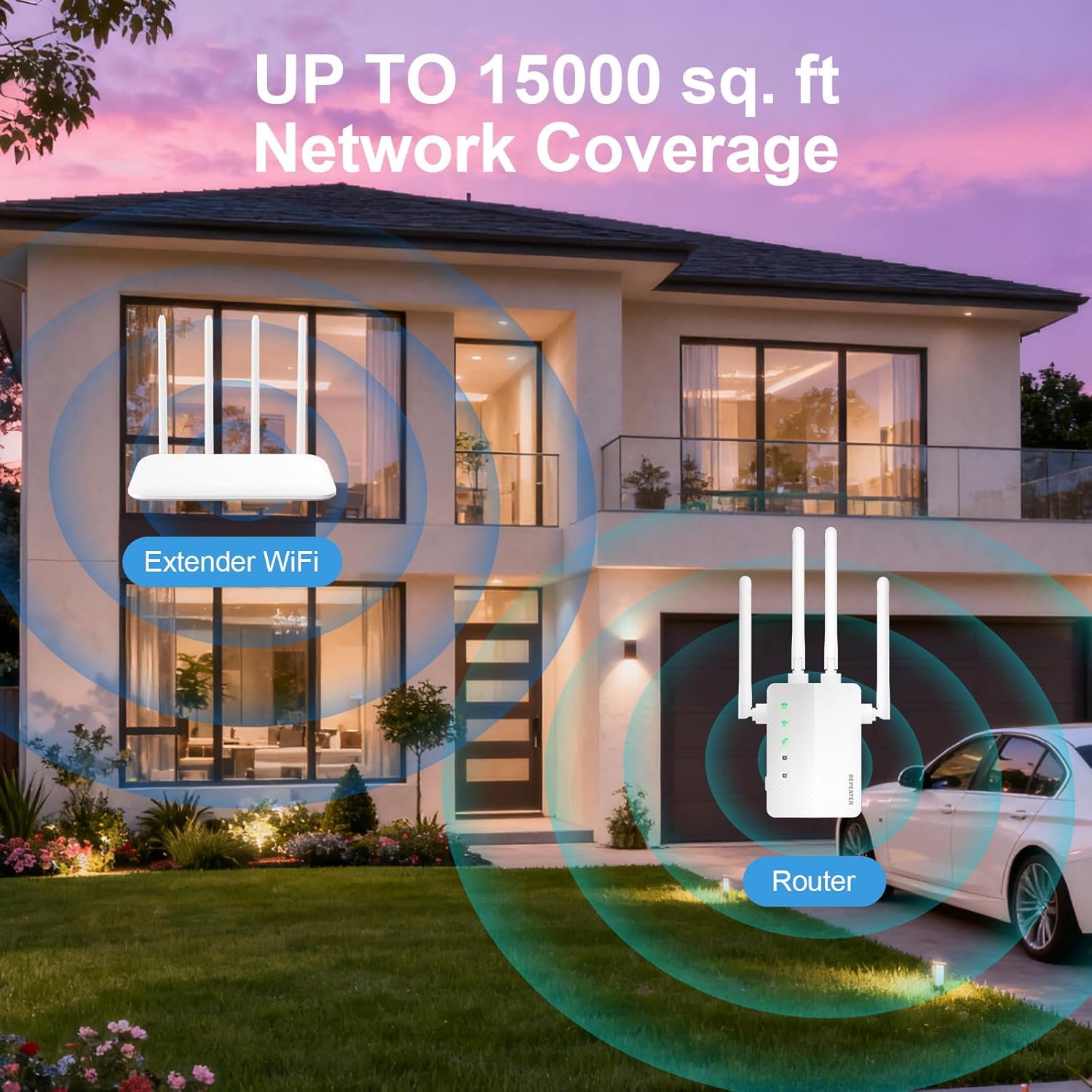
Oh man, I know the frustration. I used to get so annoyed. Picture this. It was a Tuesday night. I just wanted to relax. I sat down on my couch to watch a new movie. But the video kept buffering. The little circle spun and spun. It drove me crazy. My router is in the hallway. My living room is not far. But for some reason, the signal there was terrible. It felt like I was in a total dead zone. My old house has thick walls, and maybe that was the issue. All I know is that my favorite streaming show was unwatchable. It was a classic “first-world problem,” but it was my problem, and I needed to solve it. That is when I started looking into a WiFi extender signal booster for home.
I tried moving my router. I put it on a shelf. I even tried pointing the antennas in different directions. Nothing really worked. I was about to call my internet provider and complain. But deep down, I knew it wasn’t their fault. My internet plan is fast. The problem was the range. The signal just could not get to where I needed it. So, I went online and searched for a solution.
The search results were overwhelming. There were so many different types. I saw plug-in extenders. I saw desktop extenders. I saw something called a “mesh” system. I had no idea what to choose. I just wanted my Netflix to play smoothly. After reading a few reviews, I was even more confused. Some people loved one model, while others hated it. I didn’t want to waste my money on something that didn’t work. I am not a super tech-savvy person, so I needed something simple. I decided to buy a basic plug-in extender. It seemed like the easiest first step. I will never forget the day it arrived in the mail. I was so hopeful.
<<Get Amazon For This Product>>
Trying My First WiFi Extender Signal Booster for Home
The extender I bought was small. It looked like a little air freshener you plug into the wall. Setting it up was surprisingly easy. The instructions were simple. I had to press a button on my router and then a button on the extender. This is called “WPS,” I learned. It connected almost instantly. I was so proud of myself. The next step was the most important. Where should I put it?
The box said to put it halfway between my router and the “dead zone.” So, I plugged it into an outlet in the hallway, near my living room door. I walked to the living room and checked my phone. The WiFi bars were full! I was ecstatic. I sat down and started my movie. For about thirty minutes, everything was perfect. I thought I had solved all my problems.
But then, the buffering started again. My joy turned back into frustration. Why was it working one minute and not the next? I walked back into the hallway to check the extender. It had a little light on it. The light was orange. The manual said orange means the connection to the router is weak. I realized I had put the extender too far away from the router. It was getting a poor signal itself, so it was “boosting” a poor signal to my living room. This was an eye-opener for me. A WiFi extender signal booster for home is not magic. It needs a good source to work well. This experience taught me that placement is everything. The device itself was fine, but my placement was terrible. It was a classic beginner’s mistake. I moved it to an outlet slightly closer to the router, and that orange light turned green. Success, or so I thought.
The Problem with Speed and Dual Bands
I sat back on the couch. The green light was on. My phone showed full signal bars. The movie played. But it didn’t look right. The picture quality was grainy. It was a step up from the spinning circle, but it wasn’t the high-definition I was used to. This is where my next lesson began. I went to a speed-test website on my phone.
The speeds I was getting through the extender were much, much slower than when I was right next to the router. It was a shock. I had a full signal, but slow speeds. I did some more reading. It turns out that simple extenders often cut your WiFi speed in half. This is because they have to use the same channel to receive the signal from your router and then re-transmit it to your devices. It’s like a two-way radio. You can’t talk and listen at the same time. This was a massive drawback I had no idea about.
My “Aha!” moment came when I learned about “dual-band” and “tri-band” extenders. My basic one was only single-band (it only used the 2.4GHz frequency). It was like a one-lane road. Better extenders can use both the 2.4GHz and 5GHz bands. The 5GHz band is much faster but has a shorter range. The 2.4GHz band is slower but can go through walls better. I realized I should have bought a dual-band extender from the start. This was a classic “you get what you pay for” scenario. I needed something a bit more advanced to get the high-definition streaming I wanted. This led me to a new purchase.
Choosing the Right WiFi Extender Signal Booster for Home
This time, I was determined to get it right. I wanted something that was dual-band and supported WiFi 6. WiFi 6 is a newer standard that is faster and better at handling many devices at once. I live with my partner, and we both have smartphones, laptops, and a couple of smart speakers. All those devices can clog up the network. My new research led me to a high-end model. It seemed perfect. It was a WiFi 6 extender and promised huge coverage. It also had good reviews for being simple to set up.
When it arrived, it was definitely beefier than my first extender. It had two antennas that popped up. Setup was just as easy as before. I used an app this time, which was even better. The app helped me find the perfect spot. It told me if the signal was strong or weak. It was like a little digital guide. I ended up placing it in the hallway, about where I had tried the first time, but it works so much better because it has stronger hardware.
The difference was night and day. I can now stream 4K movies in my living room without a single glitch. The grainy picture is gone. The speeds I am getting through this device are almost as fast as when I am near the main router. It uses the 5GHz band to connect to my phone and the router, which is why the speeds are so much better. I don’t feel like I am making a compromise. I can finally enjoy my TV time without any interruption. It’s a wonderful feeling. I can even sit in the backyard and get a decent connection now.
For some of you, a simple plug-in extender might be enough. But if you are like me and want to do things like stream 4K video or play online games, you really need to look at a better model. I had to learn that the hard way. It’s easy to get drawn to the lowest price. But you will likely be disappointed. Spending a little more for a good dual-band WiFi 6 extender is a much better investment. It will save you a lot of future headaches.
Of course, a WiFi extender signal booster for home isn’t the only solution. There are other options, and I had to consider them too. For example, my neighbor has a massive, three-story house. He told me he tried extenders, but they didn’t cover everything. He ended up getting a “mesh” system. I didn’t fully understand what that was until I asked him. He showed me his setup, which was fascinating.
A mesh system is more like a team. Instead of one extender that talks to the router, a mesh system is a main router and several “nodes” you place around your house. All the nodes talk to each other. This creates a single, seamless blanket of WiFi. With an extender, you sometimes have to switch networks manually. You might be on “My_WiFi” near the router and “My_WiFi_EXT” near the extender. If you move, your phone might get confused. With a mesh system, it’s all one network. Your phone just moves from one node to the next without dropping the connection. It’s incredibly cool. My neighbor’s house, with its many rooms and floors, is now completely covered. He has no dead spots.
I also looked into powerline adapters. These are an interesting idea. They send the internet signal through your home’s electrical wiring. You plug one into an outlet near your router and connect it with an ethernet cable. Then you plug another one into an outlet in your dead zone. The signal travels from one adapter to the other through the walls. Some of these adapters even have WiFi built-in. This seems like a neat idea for homes with very thick walls where WiFi just can’t get through. I didn’t end up going this route, but it’s a valid option for many people. It really made me realize there is no single solution for everyone. The best solution for you will depend on your home and your needs.
I made a simple table to help me think about the differences. It really helped clarify my options. I should have made this before I bought my first extender.
Common WiFi Solutions Compared
| Solution | Best For | Pros | Cons |
| Simple WiFi Extender | Small homes, single dead zones | Low cost, easy setup | Slows down speeds, manual network switching |
| Dual-Band/WiFi 6 Extender | Larger homes, streaming/gaming | Much faster, better performance | Higher cost than simple ones |
| Mesh WiFi System | Large or multi-story homes | Seamless coverage, one network name | High cost, multiple devices to set up |
| Powerline Adapter | Homes with very thick walls | Goes through walls where WiFi can’t | Dependent on home wiring quality |
This table really helps to visualize the options. My cheap first extender was a textbook “Simple WiFi Extender.” The one I have now fits right into the “Dual-Band/WiFi 6 Extender” category. It has been a fantastic middle ground for me. It’s not as expensive as a mesh system, but it performs way better than a basic extender. For my two-bedroom house, it’s perfect. If I lived in a giant castle, a mesh system would probably be the only way to go. If I had 10-foot-thick stone walls, maybe the powerline adapter would be necessary. It really just highlights that everyone’s situation is different.
One of the great things I learned about a WiFi extender signal booster for home is that many models have an ethernet port on them. This is such a simple but powerful feature. I can plug my game console or smart TV directly into the extender with a cable. This gives it a rock-solid, stable connection that is often better than WiFi. If your extender is doing a good job of getting a signal, this ethernet port is a game-changer for critical devices. I used an ethernet cable to connect my old game console, and it was incredible to see my download times plummet.
So, where am I now? I am currently writing this from my living room, streaming music from a smart speaker. My partner is in the kitchen on her tablet. The WiFi extender signal booster for home is discreetly plugged in the hallway. No more buffering, no more low-quality video, no more frustration. It has made my life so much easier. I no longer think about my WiFi signal. It just works.
This whole experience was a journey. I made mistakes, I was frustrated, and I learned a lot. I learned that you shouldn’t buy the cheapest option. I learned that placement is everything. I learned about the differences between bands and standards. It feels like I went to “WiFi School.” If you are suffering from a terrible WiFi signal at home, I want you to know that there is a solution. Don’t just settle for bad internet. A good WiFi extender signal booster for home can truly fix your problems. It’s one of the best investments I have made for my home. I hope my story helps you find the right solution for you. Good luck on your own WiFi journey! It might be a little bumpy at first, but the results are so worth it. I am truly a satisfied customer.
FAQs
Does a WiFi extender slow down your speed?
Yes, simple ones can. They often cut your speed in half. But newer, dual-band, and WiFi 6 models use two bands. This keeps your connection much faster. It’s a huge improvement.
Where is the best place to put a WiFi extender?
Place it halfway between your router and the dead spot. It must still get a good signal from the router. A phone app can even help you find the best location. Proper placement is the key to success.
What is the difference between an extender and a mesh system?
An extender creates a separate network name. You may have to manually connect as you move. A mesh system creates one smooth network. It’s like having one big router that covers your entire home. It offers a truly seamless experience.
Will any WiFi extender work with my router?
Most extenders work with any standard router. But, getting a WiFi 6 extender is a smart move. It works best with modern routers. It’s like making sure your new parts fit your car perfectly.
Are WiFi extenders easy to set up?
Yes, very easy! Many use a single button to connect, called WPS. It’s often just one click. Others use a simple phone app. The app is fantastic and walks you through the whole process in minutes.